
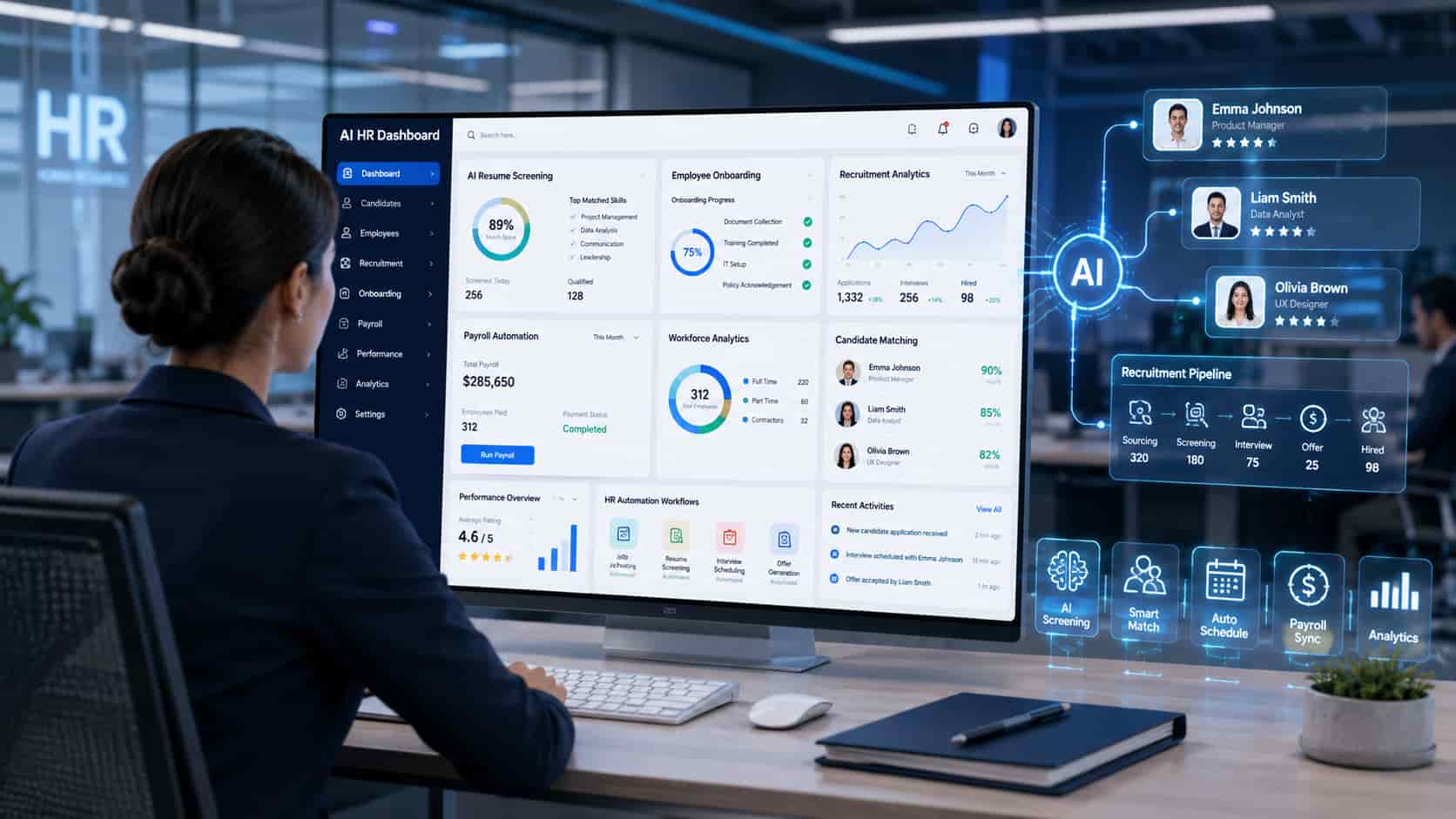
Managing people has never been simple. Reviewing resumes, onboarding new employees, answering routine questions, tracking attendance, and preparing performance reviews can quickly become overwhelming — especially for small businesses with limited HR staff.
This is where AI tools for HR can help.
Modern AI-powered HR software can screen candidates, automate onboarding, organize employee data, assist with performance reviews, generate reports, and reduce repetitive administrative work. These tools are not meant to replace HR professionals. Instead, they free up time so teams can focus on people, culture, and important decisions.
In this guide, I’ve compared the 10 best AI tools for HR in 2026, looking at features, ease of use, pricing, and suitability for small and growing businesses.
Related article AI customer service tools
How AI Is Changing HR for Small Businesses
AI is changing how small businesses handle everyday HR tasks. Instead of manually reviewing every resume, sending repetitive emails, or entering employee information into multiple systems, HR teams can use AI-powered software to automate parts of these processes.
For example, AI recruitment tools can help screen applications and identify candidates based on predefined job requirements. HR platforms can also automate employee onboarding, organize documents, manage time-off requests, and provide workforce reports.
These capabilities can be particularly useful for small businesses that have limited HR staff. By reducing repetitive administrative work, AI can give HR professionals more time to focus on recruiting, employee development, communication, and other tasks that require human judgment.
However, AI should be used as a support tool rather than as a complete replacement for human decision-making. HR teams should review important recommendations, especially when making decisions related to hiring, employee performance, compensation, or other sensitive matters.
In this guide we will look at the AI tools for HR in 2026. You will find out about each systems points, cost, features, pros and cons and which companies they work best for.
Quick Picks for 2026:
Best Overall: BambooHR
Best for Global Teams: Deel
Best All-in-One (HR + Payroll + IT): Rippling
Best Budget Option: Zoho People
Best for Employee Engagement: HiBob
Best for Simple Payroll: Gusto
Quick Recommendations: Best AI Tools for HR
| If You Need… | Recommended Tool | Why We Recommend It |
|---|---|---|
| Best Overall | BambooHR | Easy to use, with strong hiring, onboarding, and employee management features. |
| Best for Global Hiring | Deel | Supports international hiring, payroll, and compliance management. |
| Best HR + Payroll Solution | Rippling | Combines HR, payroll, IT management, and workflow automation in one platform. |
| Best Budget Option | Zoho People | Affordable HR software with useful automation and integration with the Zoho ecosystem. |
| Best for Employee Engagement | HiBob | Strong employee engagement, people analytics, and performance management features. |
| Best Payroll Software | Gusto | Simple payroll, benefits administration, and employee onboarding for small businesses. |
| Best for Performance Reviews | Leapsome | Provides performance management, employee development, learning, and engagement tools. |
| Best Recruitment Platform | Greenhouse | A powerful applicant tracking system with recruitment automation and hiring workflows. |
| Best Enterprise HR Platform | Workday | Advanced workforce planning, analytics, and enterprise HR management capabilities. |
| Best Talent Intelligence | Eightfold AI | Uses AI to support talent matching, skills intelligence, and workforce planning. |
What Are the Best AI Tools for HR?
AI tools for HR are software platforms that use artificial intelligence to help businesses automate and improve human resources tasks. These tools can assist with activities such as reviewing resumes, scheduling interviews, onboarding employees, managing HR documents, analyzing workforce data, and preparing reports.
Modern AI HR software can help with:
- Resume screening
- Candidate matching
- Employee onboarding
- Payroll support
- Attendance and time tracking
- Performance management
- Workforce analytics
- Employee engagement
- HR document management
- Recruitment automation
The main benefit of AI in HR is not simply saving time. Well-designed HR software can also reduce repetitive administrative work, improve data organization, provide useful insights, and help HR teams make more informed decisions.
However, AI should support human decision-making rather than replace it. HR professionals should review important AI-generated recommendations, particularly when they involve hiring, employee performance, compensation, or other sensitive decisions.
Why Businesses Are Using AI HR Software
Businesses of all sizes are adopting AI HR software because it can reduce repetitive administrative work and help HR teams manage employees more efficiently.
Instead of spending hours on routine tasks, HR professionals can use AI-powered tools to automate processes, organize employee information, and generate useful insights.
Some of the key benefits of AI HR software include:
Faster recruitment and resume screening
Better candidate matching
Automated employee onboarding
Improved employee experience
Reduced administrative work
More efficient HR reporting
Better workforce planning
Increased productivity
Improved compliance management
Whether a company is hiring a few employees or managing a large workforce, the right AI HR software can make everyday HR processes more organized and efficient.
However, businesses should choose tools based on their actual HR requirements rather than simply selecting a platform with the most AI features.
Companies of every size are adopting AI HR software because it removes work that slows HR teams down.
How We Selected the AI Tools for HR
Not every HR platform offers the same capabilities, so we evaluated these tools based on the features that matter most to businesses when choosing HR software.
Our comparison considered the following factors:
- AI capabilities
- Ease of use
- HR automation features
- Recruitment and hiring tools
- Payroll and benefits support
- Employee management features
- Third-party integrations
- Reporting and analytics
- Pricing and overall value
- Scalability for growing businesses
We also considered the primary use case for each platform. Some tools are designed mainly for recruitment, while others focus on payroll, employee engagement, performance management, or broader workforce management.
The result is a selection of AI HR tools covering different business needs, from startups and small businesses to growing companies and larger organizations.
However, features, pricing, and AI capabilities can change over time. Before choosing a platform, check the provider’s official website for the latest information and plan details.

Best AI Tools for HR in 2026
The best AI HR software depends on the size of your business, your HR requirements, and the tasks you want to automate.
The tools below cover different areas of human resources, including recruitment, employee onboarding, payroll, performance management, workforce analytics, and employee engagement.
We have included options for small businesses, growing companies, and larger organizations so you can compare platforms based on your specific needs.
Let’s look at the 10 best AI tools for HR in 2026.
1. BambooHR
Best for: Small and medium-sized businesses looking for an easy-to-use HR platform
BambooHR is is one of the most popular HR platforms for small and medium-sized businesses because it is easy to use and covers the most important HR processes in one place — hiring, onboarding, employee records, time off, and performance.
Its AI and automation features help reduce manual work, especially during hiring and onboarding. For many small businesses, BambooHR offers a good balance between simplicity and useful functionality.
Who should choose BambooHR:
Choose BambooHR if you want a clean, easy-to-use HR system without unnecessary complexity.
Key Features
AI-assisted HR and hiring workflows
Applicant and candidate management
Employee onboarding
Employee record management
Performance management
Time-off management
HR reporting and analytics
Workflow automation
Pros
Easy-to-use interface
Strong employee onboarding features
Employee information is organized in one platform
Useful reporting and analytics
Relatively simple to set up
Cons
Payroll availability varies by location
Some advanced features require additional costs
May not provide all the functionality needed by large enterprises
Pricing: BambooHR offers different plans and pricing options depending on the features and services required. Check the official BambooHR website for current pricing.
2. Deel
Best for: Global hiring and international teams.
Deel is particularly strong for companies that hire internationally. It helps manage contracts, compliance, payroll, and onboarding for employees and contractors across different countries.
If your business works with remote talent in multiple countries, Deel can save a significant amount of administrative and legal hassle.
Hiring employees and contractors across different countries can create additional challenges involving payroll, contracts, taxes, compliance, and employee onboarding. Deel is designed to help businesses manage many of these international employment and workforce processes from one platform.
Its AI-powered capabilities can assist with tasks such as generating employment-related documents, answering HR questions, and streamlining certain administrative workflows. Businesses can also use Deel to manage global payroll, contractors, employee documentation, and international workforce processes.
For companies that regularly hire people in different countries, Deel can be a useful option for simplifying global HR administration.
Key Features
AI-powered HR assistance
Employment and contractor management
Global payroll
International hiring support
Employee and contractor onboarding
Document management
Compliance support
HR workflow automation
Pros
Designed for international hiring
Supports global payroll and workforce management
Helps simplify HR administration
Useful for managing employees and contractors
Centralized platform for global workforce processes
Cons
Pricing can become expensive as your workforce grows
Some features and services vary by country
Advanced functionality may require additional plans or services
Pricing: Deel offers different pricing depending on the services and workforce solutions required. Check the official Deel website for current pricing and availability.
3. Rippling
Best for: Businesses that want HR, payroll, IT, and workflow automation in one platform.
Rippling stands out because it combines HR, payroll, benefits, and IT management in one platform. When you hire someone, it can help set up their employee record, payroll, and even software access automatically.
This makes it a powerful option for growing businesses that want to reduce the number of separate tools they use.
Rippling combines HR, payroll, benefits administration, IT management, and workflow automation in a single platform. This can be useful for growing businesses that want to manage employee-related processes without relying on multiple separate systems.
For example, when a new employee joins the company, Rippling can help automate parts of the onboarding process, including employee records, payroll setup, application access, and other administrative tasks.
Its automation capabilities can reduce repetitive work and help businesses manage employee information more efficiently.
Key Features
Employee onboarding and offboarding
Payroll management
Benefits administration
Workflow automation
Employee lifecycle management
IT and application management
Reporting and analytics
Integrations with business applications
Pros
Combines HR, payroll, and IT management
Powerful workflow automation
Supports customized workflows
Scales with growing businesses
Integrates with many business applications
Cons
Pricing is not always straightforward
The platform can take time to learn
Some features may be unnecessary for very small businesses
Pricing: Pricing varies depending on the products and services selected. Check the official Rippling website for current pricing.
4. Workday
Best for: Large organizations and enterprises
Workday is an enterprise-focused platform that combines human capital management, workforce planning, analytics, talent management, and other business functions.
Its AI capabilities can help organizations analyze workforce data, identify skills, support talent management, and improve workforce planning. These features are particularly useful for large organizations managing complex workforce requirements.
Workday may offer more functionality than a small business needs, but it can be a strong option for organizations that require advanced HR management and analytics.
Key Features
AI-powered workforce insights
Talent management
Workforce planning
Skills management
Employee experience tools
HR workflow automation
Workforce analytics
Performance and talent management
Pros
Designed for large organizations
Advanced workforce analytics
Broad HR functionality
Strong reporting capabilities
Highly scalable
Cons
Can be complex to implement
Requires more training than simpler HR platforms
May be excessive for small businesses
Pricing is generally customized
Pricing: Workday uses customized pricing based on the organization’s requirements.
5. Zoho People
Best for: Small businesses and companies already using Zoho products.
Zoho People is one of the more affordable options and works especially well if you already use other Zoho products. It covers core HR needs such as attendance, leave management, performance, and employee records, with useful automation features.
Zoho People is especially an HR management platform designed to help businesses manage employee information, attendance, time off, onboarding, performance, and HR workflows.
One of its biggest advantages is its integration with the wider Zoho ecosystem. Businesses already using products such as Zoho CRM or Zoho Books can connect their HR processes with other business operations.
Zoho People can be a practical choice for small businesses looking for affordable HR software with useful automation and employee management features.
Who should choose Zoho People:
Choose Zoho People if budget is a major concern and you want a practical HR system.
Key Features
– Employee information management
– Attendance tracking
– Leave management
– Employee onboarding
– Performance management
– HR workflow automation
– Employee self-service
– Custom reports
– Zoho integrations
Pros
– Affordable compared with many enterprise HR platforms
– Easy to get started
– Integrates with the Zoho ecosystem
– Suitable for growing businesses
– Useful HR automation features
Cons
– AI capabilities may be less extensive than those of some enterprise platforms
– Some advanced features require higher-tier plans
– Businesses outside the Zoho ecosystem may not benefit as much from its integrations
Pricing: Zoho People offers multiple plans. Check the official Zoho website for current pricing and available features.
6. HiBob
Best for: Growing businesses focused on employee engagement and company culture
HiBob, also known as Bob, is an HR platform designed to help growing companies manage employees while improving engagement, performance, and workplace culture.
The platform provides people analytics, employee engagement tools, performance management, goal tracking, and workforce reporting. These features can help HR teams understand employee trends and make more informed workforce decisions.
HiBob is particularly useful for companies that want to combine traditional HR management with employee experience and engagement tools.
Key Features
– People analytics
– Employee engagement surveys
– Performance management
– Goal tracking
– Compensation management
– Workforce reporting
– Employee insights
– HR workflow automation
Pros
– Strong employee engagement features
– Modern interface
– Useful workforce analytics
– Good integration options
– Suitable for growing companies
Cons
– May be expensive for very small businesses
– Some organizations may not need its broader feature set
– Pricing depends on company requirements
Pricing: HiBob provides customized pricing based on the organization’s needs.
7. Gusto
Best for: Small businesses that need payroll and basic HR management
Gusto is a popular platform for small businesses that want to manage payroll, benefits, employee onboarding, and other HR tasks from one system.
Its automation features can help businesses handle recurring payroll processes, employee documentation, benefits administration, and other routine tasks.
Gusto is particularly attractive to small businesses because of its relatively simple interface and focus on payroll and employee management.
Key Features
– Payroll automation
– Employee onboarding
– Benefits administration
– Hiring and employee management
– Time tracking
– HR document management
– Employee self-service
– Automated reminders and workflows
Pros
– Easy to use
– Strong payroll features
– Suitable for small businesses
– Simple employee onboarding
– Helpful HR automation
Cons
– International payroll capabilities are limited compared with global HR platforms
– Advanced HR features may require higher-tier plans
– Availability of certain features depends on location
Pricing: Gusto offers several subscription plans. Check the official Gusto website for current pricing and plan features.
8. Leapsome
Best for: Performance management, employee development, and learning
Leapsome is an employee management platform focused on performance, engagement, learning, and professional development.
Its AI-powered features can help managers prepare performance reviews, generate useful suggestions, summarize feedback, and support employee development.
For companies that want to build a continuous feedback and learning culture, Leapsome can be a useful addition to their HR technology stack.
Key Features
– AI-assisted performance reviews
– Goal management
– Employee learning
– Feedback management
– Employee engagement surveys
– HR analytics
– Career development
– Learning recommendations
Pros
– Strong performance management tools
– Modern interface
– Flexible review processes
– Useful employee learning features
– AI-assisted HR workflows
Cons
– May be more expensive than basic HR software
– Some small businesses may not need its full feature set
– Pricing depends on company requirements
Pricing: Leapsome provides customized pricing. Check the official website for current plans and features.
9. Greenhouse
Best for: Recruitment and structured hiring
Greenhouse is an applicant tracking and recruiting platform designed to help organizations manage the hiring process from job creation through candidate evaluation and hiring.
Its recruitment tools can help teams organize applications, coordinate interviews, collaborate on candidate evaluations, and analyze hiring data.
For businesses with frequent recruitment needs, Greenhouse can provide a more structured approach to managing the hiring pipeline.
Key Features
– Applicant tracking system
– Resume and candidate management
– Interview scheduling
– Recruitment analytics
– Hiring workflow automation
– Candidate communication
– Hiring team collaboration
– Recruitment reporting
Pros
– Strong recruitment workflows
– Comprehensive applicant tracking
– Good collaboration features
– Useful hiring reports
– Scalable recruitment platform
Cons
– Primarily focused on recruitment
– May be more than a small business needs
– Pricing is customized
Pricing: Greenhouse provides customized pricing based on the organization’s requirements.
10. Eightfold AI
Best for: Talent intelligence and workforce planning
Eightfold AI is a talent intelligence platform that uses AI to help organizations understand employee skills, match candidates with opportunities, identify skill gaps, and support workforce planning.
Instead of focusing only on filling open positions, the platform can help businesses think about longer-term talent strategies, including internal mobility and employee development.
Eightfold AI is primarily designed for larger organizations with complex workforce and talent-management requirements.
Key Features
AI-powered talent matching
Skills intelligence
Internal mobility recommendations
Workforce planning
Career development recommendations
Talent analytics
Employee skill mapping
Talent acquisition tools
Pros
Advanced talent intelligence
Strong candidate and talent matching
Workforce analytics
Supports internal career development
Designed to scale for large organizations
Cons
Primarily aimed at larger organizations
May be too complex for small businesses
Pricing is customized
Pricing: Eightfold AI provides customized pricing based on the organization’s requirements.
Comparison Table for the Best AI Tools for HR
| HR Tool | Best For | Key AI Features | Free Plan | Pricing |
|---|---|---|---|---|
| BambooHR | Small and medium-sized businesses | AI hiring, onboarding, employee records, reporting | No | Custom quote |
| Deel AI | Global hiring | AI contracts, global payroll, compliance, onboarding | No | Custom pricing |
| Rippling | HR, payroll, and IT | Workflow automation, payroll, onboarding, device management | No | Custom pricing |
| Workday AI | Large enterprises | Talent matching, workforce planning, predictive analytics | No | Custom quote |
| Zoho People | Budget-friendly HR | Attendance, leave management, onboarding, HR workflows | Yes | Low-cost monthly plans |
| HiBob | Employee engagement | People analytics, engagement surveys, goal tracking | No | Custom quote |
| Gusto | Payroll and HR | Payroll automation, onboarding, benefits management | No | Monthly subscription |
| Leapsome | Performance management | AI review assistance, learning management, HR analytics | No | Custom pricing |
| Greenhouse | Recruitment | ATS, AI-assisted hiring workflows, interview scheduling | No | Custom quote |
| Eightfold AI | Talent intelligence | AI talent matching, skills intelligence, workforce planning | No | Custom quote |
How to Choose the Best AI Tools for HR
Choosing the right AI tools for HR is not about selecting the platform with the most features. The best solution should address your company’s HR needs while fitting your budget, team size, and long-term goals.
Before buying an AI recruitment tool or HR automation software, consider the following factors.
1. Company Size
Start by considering how many employees your company has today and how much you expect your workforce to grow over the next few years.
If you run a startup with fewer than 50 employees, you may not need an enterprise-level platform with advanced workforce planning features. A simpler solution such as Zoho People, BambooHR, or Gusto may be a better fit.
Larger companies, on the other hand, may benefit from platforms such as Workday AI or Eightfold AI, which offer advanced analytics and workforce intelligence.
2. Recruitment Needs
Some businesses hire only a few employees each year, while others recruit regularly.
If recruitment is your main challenge, look for AI recruitment tools that offer:
- Resume screening
- Candidate matching
- Interview scheduling
- Applicant tracking system (ATS)
- Hiring analytics
- Automated candidate communication
Platforms such as Greenhouse, BambooHR, and Deel can be worth considering depending on your hiring requirements.
3. Automation Features
One of the biggest advantages of AI tools for HR is automation.
Instead of manually completing repetitive tasks every day, the software should help automate processes such as:
- Employee onboarding
- Leave management
- Payroll processing
- Attendance tracking
- HR document management
- Performance reviews
- Employee reminders
- Workflow approvals
The more repetitive work your software can handle, the more time your HR team can spend supporting employees and improving the overall employee experience.
4. Integrations
Check whether the HR software works with the tools your business already uses. Useful integrations may include payroll software, accounting platforms, communication tools, calendars, and other business applications.
Good integrations can reduce duplicate data entry and make it easier for your HR team to manage employee information from one place.
5. Data Security and Compliance
HR systems handle sensitive employee and applicant information, so security should be an important consideration.
Before choosing an AI HR platform, check how it protects employee data, manages user access, and supports applicable privacy and compliance requirements.
6. Ease of Use
A powerful HR platform is not useful if employees and managers find it difficult to use.
Look for a system with a clear interface, simple workflows, useful documentation, and reliable customer support. If possible, use a free trial or product demonstration before making a purchase.
7. Scalability
Think about your company’s future needs, not just your current requirements.
A small business may only need basic employee management today, but its HR needs can become more complex as the workforce grows. Choose a platform that can add users, features, integrations, and automation as your business expands.
8. AI Features and Human Oversight
AI can make HR processes faster, but important decisions should not be left entirely to automated systems.
HR professionals should review AI-generated recommendations, especially when they involve hiring, employee performance, compensation, or other decisions that can significantly affect people.
The best approach is to use AI to reduce repetitive work and provide useful insights while keeping humans involved in important decisions.
Want to Know more click AI invoice management software
Frequently Asked Questions
What are the best AI tools for HR?
The best AI tools for HR are tools like BambooHR, Rippling, Deel AI Zoho People, Workday AI, HiBob, Greenhouse, Gusto, Leapsome and Eightfold AI. The best AI tools for HR for your company will depend on how big your company’s what your hiring needs are and what your budget is.
Can AI replace HR professionals?
No AI cannot replace HR professionals.
AI tools for HR can do work like looking at resumes, scheduling interviews getting new employees started and making reports.. Hr professionals are still very important for things like helping employees being a leader resolving conflicts and planning the workforce.
You should consider AI tools for HR as helpers, not replacements.
What is the best AI recruitment tool?
If your main focus is on hiring then Greenhouse, Deel AI and BambooHR are some of the AI recruitment tools available now. These AI tools for HR make the hiring process easier. Help recruiters find good candidates faster.
Is AI HR software suitable for businesses?
Yes AI HR software is suitable for businesses.
Many companies now offer AI HR software that’s affordable and made just for small businesses and startups. Zoho People, Gusto and BambooHR are choices for companies that need to automate things without it being too complicated.
Are AI HR tools secure?
When it comes to keeping employee data safe most companies use an important things. They use encryption to protect the data. They also use role-based access controls.
Before you pick a platform you should do some research. Look at the security certifications of the platform. Check the privacy policies of the platform. See what compliance features the platform has. This will help you choose a platform that keeps employee data safe like encryption and role-based access controls do.
Final Thoughts
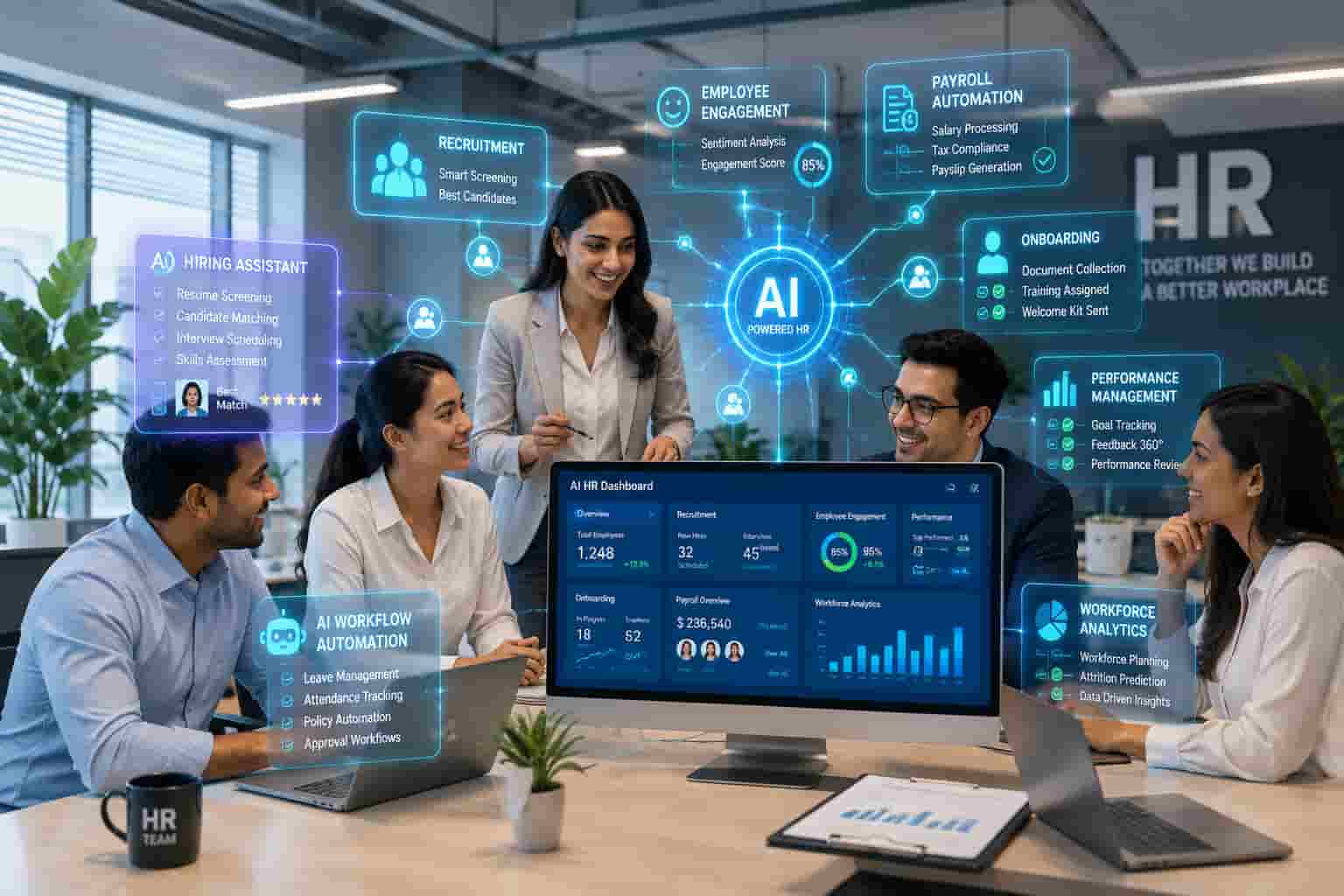
AI tools for HR can help businesses reduce repetitive administrative work, improve recruitment, automate employee processes, and make better use of workforce data.
The right platform depends on your company’s size, budget, hiring needs, and long-term goals.
For small and medium-sized businesses, BambooHR, Zoho People, and Gusto are worth considering for everyday HR management. Companies hiring internationally may find Deel more suitable, while businesses that need HR, payroll, and IT automation can consider Rippling.
Larger organizations with complex workforce requirements may benefit from platforms such as Workday AI or Eightfold AI.
Before choosing an AI HR tool, take advantage of free trials or product demonstrations whenever available. Test the software with your actual HR workflows and make sure it is easy for your team to use.
Most importantly, treat AI as a tool to support HR professionals, not as a replacement for human judgment. The best HR technology should save time while helping businesses create a better experience for both employees and candidates.
Explore AI customer feedback tools
For most small businesses in 2026, BambooHR is the best overall AI-powered HR platform because it is easy to use and covers the essential HR processes well.
However, the right choice depends on your needs:
Want the simplest and most balanced HR platform? → BambooHR
Hire people in multiple countries? → Deel
Want HR + Payroll + IT in one system? → Rippling
Need the most affordable option? → Zoho People
Focused mainly on payroll and benefits? → Gusto
Start with a free trial or demo of your top two options and test them with real HR processes before deciding.