
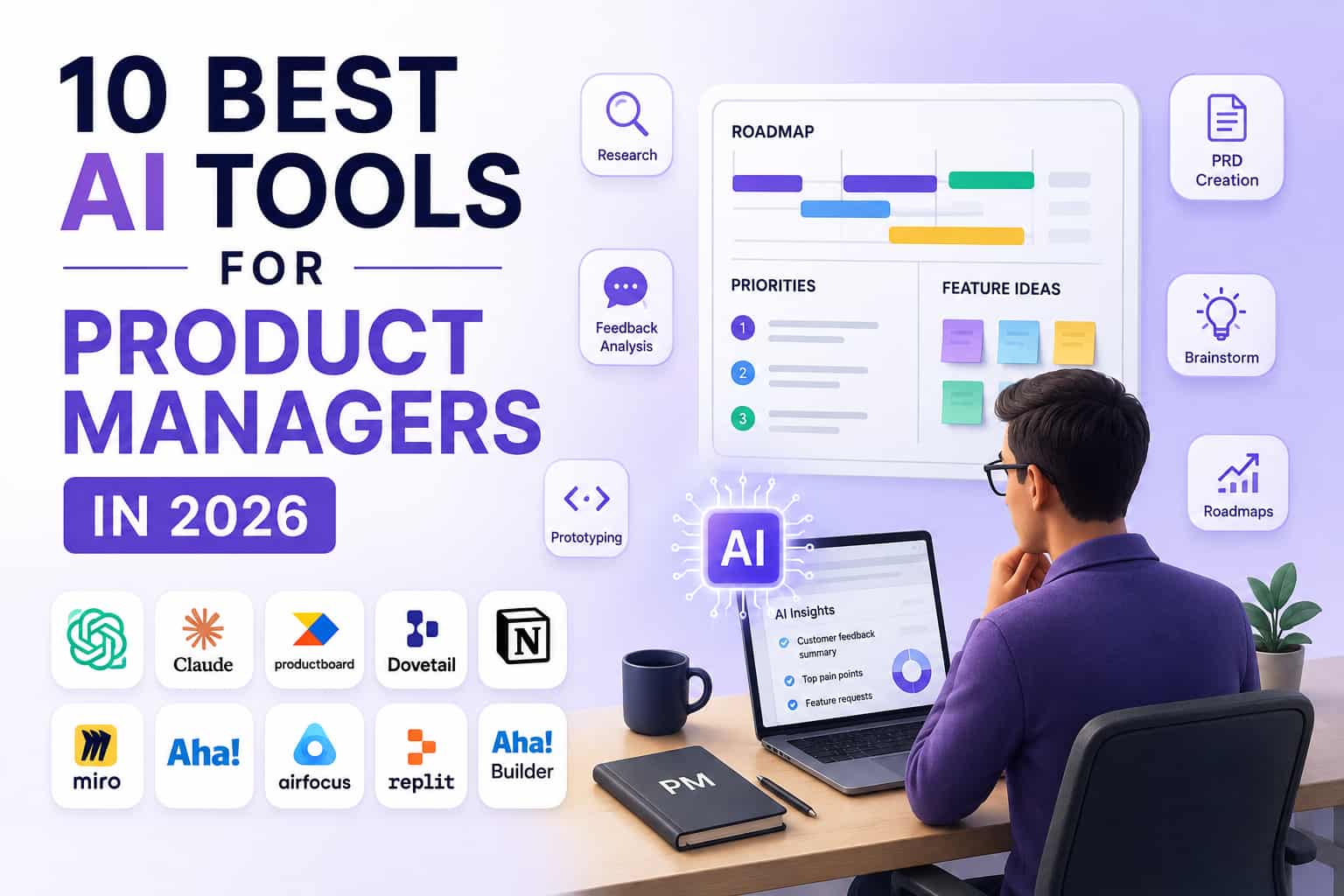
Product managers juggle a lot. One morning you’re digging through customer feedback. Before lunch you’re writing a PRD. By afternoon you’re updating a roadmap or prepping a stakeholder note.
AI can take some of that load. The useful tools in 2026 go beyond basic writing help. They support research, strategy, roadmaps, documentation, brainstorming, prototypes, and feedback analysis.
You don’t need twenty of them. Pick a few that fit how your team already works. Here’s a look at ten solid options, what each does well, pricing, pros and cons, and who they’re best for.
Quick Comparison For AI Tools For Product Managers
| AI Tool | Best For | Starting Price | Best Use |
|---|---|---|---|
| ChatGPT | General product work | Free / $20 per month | Research, writing, and analysis |
| Claude | PRDs and long documents | Free / $20 per month | Research and documentation |
| Productboard | Feedback and roadmaps | Free / $19 per maker/month | Prioritization and planning |
| Dovetail | Customer research | Free | Feedback and research analysis |
| Notion AI | Product documentation | Free / $10 per member/month | Notes, docs, and knowledge |
| Miro | Brainstorming and planning | Free / $8 per member/month | Whiteboards and collaboration |
| Aha! | Strategy and roadmaps | From $59/user/month | Roadmapping and strategy |
| airfocus | Prioritization | Contact sales | Roadmaps and prioritization |
| Replit | Rapid prototypes | Free / $20 per month | Building prototypes |
| Aha! Builder | AI-powered prototypes | From $59/user/month | Building applications |
Pricing can change. Check the provider’s official website for the latest pricing and plan details before purchasing.
What Are AI Tools for Product Managers?
These are tools that use AI to speed up everyday product work. They help summarize interviews, draft PRDs, brainstorm ideas, prioritize features, build roadmaps, prepare updates, and create early prototypes.
Some are general AI assistants. Others are built for product teams. The right one depends on where you spend most of your time.

1.ChatGPT
Best for: General product management work
ChatGPT is one of the most flexible options available. You can brainstorm ideas, summarize research, write interview questions, draft PRDs, analyze spreadsheets, prep stakeholder updates, and turn rough notes into something usable.
It’s especially handy when you need a first draft fast instead of staring at a blank page.
ChatGPT Plus is $20 a month in the US. Free and higher-tier plans exist too.
Key features
– PRD and product brief drafting
– Customer research summaries
– Brainstorming
– Data and file analysis
– Competitive research
– User story creation
– Product documentation
– Meeting and project summaries
Pros
Very flexible
Easy to learn
Works across many PM tasks
Handles text
files
analysis
research.
Cons
Not a dedicated product platform. You have to give it good context. Important decisions still need your judgment.
Best for
Product managers who want one general AI assistant that covers a lot of different work.
2. Claude
Best for: PRDs, research, and long documents
Claude shines when you’re dealing with long documents or big piles of research. Feed it customer interviews, notes, or requirements and ask it to find patterns, summarize, or draft something structured.
Claude Pro costs $20 a month in the US.
Key features
– Long-document analysis
– PRD drafting
– Research summaries
– Product requirements
– Brainstorming
– Writing and editing
– Structured analysis
Pros
Handles lengthy content well
Solid writing quality
Good at research synthesis
Simple interface
Cons
Not a full product-management platform
For some advanced use needs a paid plan
You still need to check important conclusions
Best for
Product managers who spend a lot of time with customer research, product documents, and detailed specs.
3. Productboard
Best for: Product feedback and prioritization
Productboard is closer to a traditional product platform than a general chatbot. Its AI helps analyze feedback, generate feature specs, and turn customer insights into decisions. It also includes Spark, an AI-focused experience for product makers.
There’s a free plan. The Plus plan starts at $19 per maker per month when billed annually.
Key features
– Customer feedback analysis
– Product roadmaps
– Feature prioritization
– AI-generated product specs
– Product briefs
– Customer insights
– Product planning
Pros
Built for product teams. Strong feedback-to-roadmap flow. Helpful for prioritization. Free option available.
Cons
Can be more than a small team needs. Advanced features often require paid plans. Takes time to set up well.
Best for
Teams that want to connect customer feedback, strategy, prioritization, and roadmaps in one place.
4. Dovetail
Best for:Customer research and feedback
If your decisions lean heavily on interviews and feedback, Dovetail is worth a look. It gives you a central place to store research and uses AI to summarize and analyze conversations, documents, calls, and surveys.
It has a free plan, with paid options for more advanced needs.
If customer feedback is a big part of your workflow, you may also want to explore AI customer feedback tools for small businesses.
Key features
– Customer interview analysis
– AI summaries
– Feedback analysis
– Research repositories
– Customer insights
– AI-powered search
– Survey analysis
Pros
Excellent for customer research
Keeps research organized
Makes large amounts of feedback easier to handle
Free plan available.
Cons
More specialized than general AI tools
Advanced features target larger teams
May be overkill for small projects.
Best for
Product managers who want to turn customer feedback and research into clear insights.
5. Notion AI
Best for: Product documentation and team knowledge
Many product teams already live in Notion for docs, notes, specs, and internal knowledge. Adding AI makes it more useful. You can draft documents, summarize information, search the workspace, and automate some tasks.
Notion has a free plan. Plus starts at $10 per member per month. Notion AI comes with Business and Enterprise plans, with limited trial access on others.
Key features
– Product documentation
– AI writing
– Meeting notes
– Workspace search
– Product briefs
– Knowledge management
– AI agents
Pros
Combines documentation and AI
Easy to organize product information
Good for collaboration. Useful beyond pure product work.
Cons
Large workspaces can get complicated. AI features depend on the plan. Not a dedicated roadmapping tool.
Best for
Product managers who want AI-powered documentation and a central place for product information.
6. Miro
Best for: Brainstorming and product planning
Miro works well for product discovery and team workshops. Its AI can generate diagrams, tables, summaries, and other content right on the board. It also supports AI workflows and integrations.
There’s a free plan. Starter starts at $8 per member per month when billed annually.
Key features
– AI brainstorming
– Mind maps
– Product workshops
– Customer journey mapping
– Diagrams
– Roadmap planning
– AI summaries
– Interactive prototypes
Pros
Great for visual thinking
Easy for teams to collaborate
Free plan available
Strong AI and integration options
Cons
Can feel overwhelming at first. Large boards get messy. Some advanced features need paid plans.
Best for
Product managers who run brainstorming sessions, discovery workshops, planning meetings, and visual exercises.
7. Aha!
Best for: Product strategy and roadmaps
Aha! focuses on strategy, roadmaps, ideas, and planning. Its AI assistant helps with writing and product planning tasks. Aha! Roadmaps starts at $59 per user per month when billed annually. Other Aha! products have separate pricing.
Key features
– Product roadmaps
– Product strategy
– Feature prioritization
– Ideas management
– AI writing assistant
– Product planning
– Dependencies
– Product reporting
Pros
Strong strategy features
Excellent for structured roadmaps
Built for product teams
Plenty of planning tools
Cons
More expensive than general AI tools. Can be too much for a solo PM. Takes time to configure.
Best for
Product managers working on larger products, structured roadmaps, and long-term strategy.
8. airfocus
Best for: Prioritization and roadmaps
Teams often struggle with what to build next. airfocus helps with that. It combines roadmaps, prioritization, feedback, insights, and AI. Professional and Enterprise plans use request-based pricing.
Key features
– Feature prioritization
– Product roadmaps
– Feedback management
– Product insights
– AI assistance
– OKRs
– Jira integration
– Azure DevOps integration
Pros
Strong prioritization features
Good for strategy
Flexible views
Useful integrations
Cons
Pricing isn’t straightforward
Better for established teams
May be unnecessary for simple projects
Best for
Teams that need a clearer way to prioritize features and connect strategy with execution.
9. Replit
Best for:Rapid product prototypes
This is where AI starts changing the workflow more noticeably. A product manager can describe an idea and use Replit’s AI tools to create a working prototype without waiting for a full development cycle.
It doesn’t replace engineers. It lets PMs test ideas earlier and show stakeholders something concrete.
Replit has a free Starter plan. Core is $20 per month when billed annually. Higher tiers exist for teams.
Key features
– AI app building
– Rapid prototyping
– AI coding assistance
– Full-stack app creation
– Database support
– Deployment
– Visual editing
Pros
Great for quick prototypes
Lets PMs test ideas faster
Useful for early MVPs
Free option available
Cons
More technical than traditional PM tools
AI-generated apps still need testing
Production work usually requires engineering help
Best for
Product managers who want to turn an idea into a working prototype quickly.
10. Aha! Builder
Best for:Building AI-powered prototypes
Aha! Builder takes prototyping a step further. It helps product teams create applications and prototypes with AI while keeping the work tied to product strategy.
It starts at $59 per user per month, with a free trial available.
Key features
– AI application building
– Rapid prototypes
– AI coding assistant
– Built-in database
– Product personas
– Product goals
– Deployment
– Product feedback
Pros
Designed with product teams in mind
Connects planning with building
Useful for testing ideas
AI-assisted development.
Cons
Higher cost than basic AI assistants
Not necessary for every PM
Generated applications still need testing
Best for
Product managers who want to move from idea to working prototype without a completely separate development process.
How AI Helps Product Managers
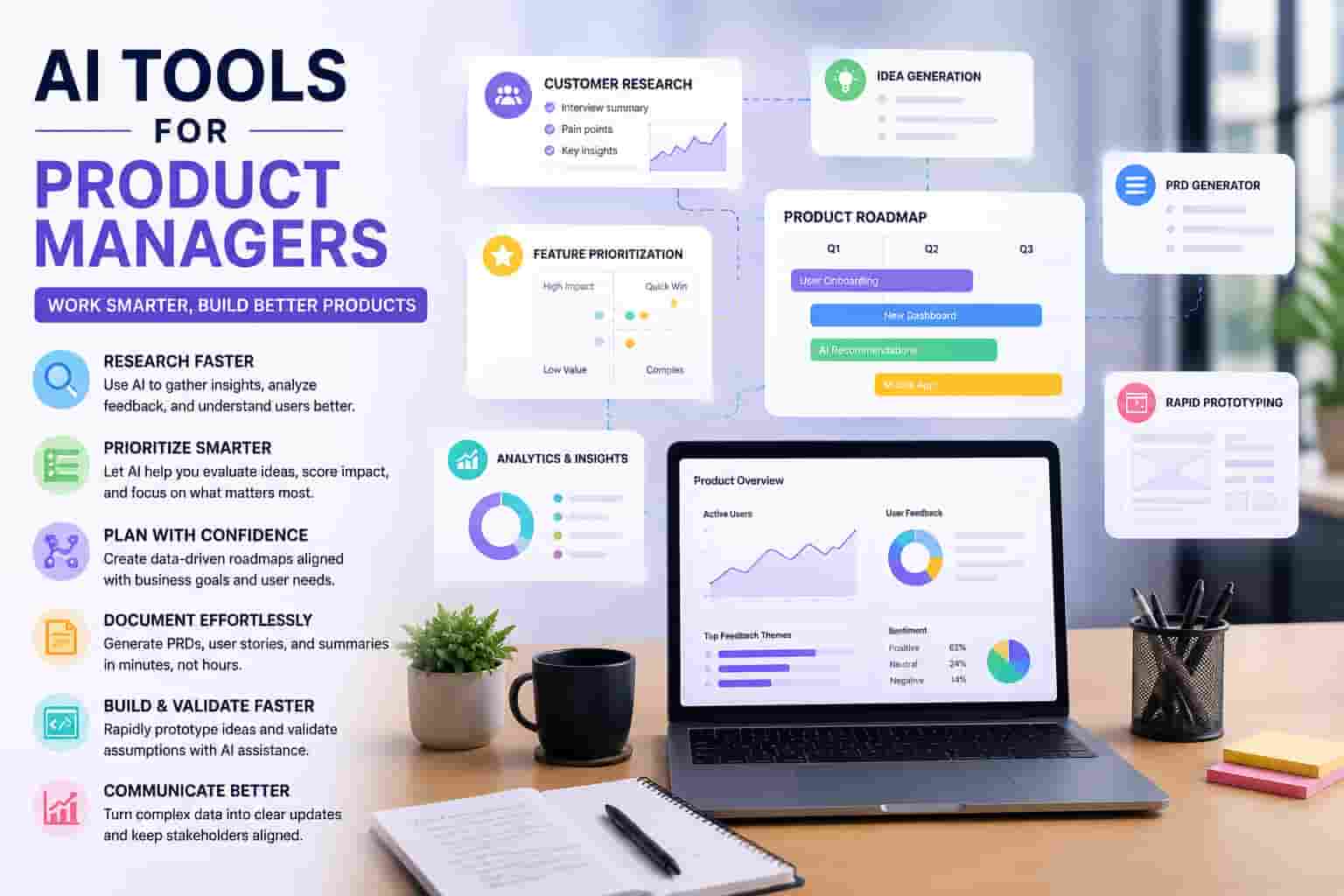
AI saves time across most stages of the work.
Customer research
It can summarize interviews, group similar feedback, and surface recurring problems. Instead of reading 50 interview notes one by one, you can pull out common themes and then check the source material yourself.
Teams that handle a high volume of customer questions can also benefit from AI customer service tools for small businesses.
Product requirements
Writing a first PRD from scratch takes hours. AI can turn rough notes into a structured draft with goals, requirements, user stories, and acceptance criteria. You still review and edit it, but you don’t start from zero.
You can take this further by connecting repetitive product tasks with AI workflow automation for small businesses.
Product roadmaps
AI can help organize ideas and summarize priorities. It shouldn’t decide the roadmap. That still needs to reflect business goals, customer needs, technical limits, and resources.
Prototyping
Tools like Replit let PMs create early versions of an idea quickly. That makes it easier to test assumptions before committing significant engineering time.
Stakeholder communication
AI can turn detailed product information into shorter updates for executives, sales, customer success, or developers. This is one of the simplest ways a busy PM can reclaim time.
For teams that work closely with sales, AI sales assistant software for small businesses can help with lead follow-up and customer communication.
How to Choose the Best AI Tool for Product Management
Don’t start with “What’s the most powerful tool?” Start with “What takes too much time right now?”
If research is the bottleneck, look at Dovetail.
If feedback and prioritization are the issue, try Productboard or airfocus.
If documentation is slowing you down, Notion AI can help.
If the team needs visual collaboration, Miro is a strong option.
If you want to build prototypes fast, Replit or Aha! Builder make sense.
You don’t have to replace your whole stack. Adding one AI tool to an existing workflow is often enough.
Are AI Tools Replacing Product Managers?
No.
AI handles a lot of repetitive work. Product management still requires judgment. Someone has to understand customers, decide which problems matter, balance business goals with user needs, talk to stakeholders, and own the decisions.
Treat AI as a capable assistant, not the person making the final call. The product managers who get the most from it are usually the ones who know what to hand off and what still needs a human.
Final Thoughts
The best AI tools for product managers depend on the job in front of you.
ChatGPT and Claude work well as general-purpose options. Productboard is stronger for feedback and prioritization. Dovetail fits customer research better.
For documentation and collaboration, Notion AI and Miro are useful. Teams that need deeper strategy and roadmapping should look at Aha! or airfocus.
If rapid prototyping is the priority, Replit and Aha! Builder are worth trying.
You don’t need all ten. Start with one clear problem, pick one tool, and see if it actually saves time. If it does, go from there.
Frequently Asked Questions
What are the best AI tools for product managers in 2026?
ChatGPT, Claude, Productboard, Dovetail, Notion AI, and Miro rank among the strongest. The right choice depends on whether you need help with research, documentation, prioritization, roadmaps, collaboration, or prototyping.
Can AI help product managers write PRDs?
Yes. ChatGPT and Claude can create first drafts from notes, requirements, research, and ideas. Dedicated product platforms can also link requirements with feedback and roadmaps.
What is the best free AI tool for product managers?
ChatGPT and Claude both offer free options. Productboard and Dovetail have free plans too, though the limits and features vary.
Can AI build a product prototype?
Yes. Tools like Replit can create working applications and prototypes from natural-language instructions. Prototypes still need testing and review before anyone treats them as production-ready.
Should a small product team use multiple AI tools?
Not necessarily. Start with one tool that solves a real problem. Add another only when you clearly need it.